TOP 5 BRIEF 2

Subject: Feminist Film Theory, how women are presented in the film industry.

Review 1

Melanie Bell (2011) Feminism and women’s film criticism in post-war Britain, 1945–1959, Feminist Media Studies, 11:4, 399-416, 11 April 2011.

In the article, Melanie Bell highlights that there was feminism in the year of 1945 to 1959. A lot of people such as myself thought that feminism in cinema started in the 1960s. Bell argues that cross-media focuses on productive methods for generating insights into women articles agency. And women in film are presented on a broader scale when it comes to gender in British society.

In 1930s Hedda Hopper and Louella O.Parson who were columnists for film reviews were powerful American women. The famous film stars at the time were quite frightened of these film critics due to what they were going to publish about them in the newspapers. During the 1950s feminist film theory and female authors trailed off and did not re-emerge until the late 1960s.

By reading this article, I can see why a lot of women with respectable jobs were fed up with having negative stereotypes in films. The world was so dominated by men in the film industry that women were over-looked, and Men presented women as housewives and mothers who had to give up their employment opportunities.

This part of the article was quite sad to read because although women could do much more, it was all down to characterised gender and sexual politics.

The representation of women in film was negative and derogatory and was a product of Male fantasy witch lead women to be presented as either helpless and passive or as sexual objects.

Not only did Smith call for “women to be shown in a much wider variety of roles” which would “provide more constructive models for film viewers,” but she also expressed the hope that women’s active involvement across all filmmaking roles would go some way to correcting negative stereotypes (Smith [1972]1999, p. 15).


Review 2

Jean-Anne Sutherland & Kathryn M. Feltey (2017) Here’s looking at her: an intersectional analysis of women, power and feminism in film, Journal of Gender Studies, 26:6, 618-631, 04 March 2016.

Jean – Anne Sutherland and Kathryn M. Feltey analyse women in power and feminism in film. They explore what makes a film feminist from a sociological perspective, by looking into Gender, Race, Ethnicity and Social class in films about women.

The article researches on how much power do women have and how they are depicted in film. This revolves around stories about the ability of women finding the courage to confront challenges in film and individually. So when a strong woman is in a film, they are always represented as middle-class white women. But when there’s a woman of colour. They are mostly featured as having less power.

In the 1970s films always tackled the image of women and represented them as either in stereotypical roles or as positive role models depending on the narrative.

Some women show solidarity in their mutual circumstances, such as in the movie Thelma and Louise 1991. They know women and men filmmakers with feminist values will give women actors better roles. However, this unfortunately is not always the case.

Press and liebes-Plesner (2004) identify four key features: (1) women are present in central roles; (2) there is variation in age-range, size, sexuality, race, and appearance of women on screen beyond the usual narrow parameters; (3) women are seen in roles with power and status, and (4) there are variations from the hetero-normative depictions of family (14). Aside from the occasional independent film, Hollywood, according to Press and Liebes-Plesner, has not delivered feminism on the modern screen. Hollywood, in fact, ‘pays lip service to feminism’ by inserting stronger women characters who are limited by sexist stereotypes (p. 16).

Strong women in Hollywood films are sometimes not portrayed with traditionally feminine features such as compassion and sensitivity. They are sometimes described as successful but struggle with loneliness, and Isolation like Meryl Streep’s character in The Devil Wears Prada, 2006.

If they get more women as writers and directors, there would be more speaking roles for women and girls. Some black directors such as Spike Lee, although tell stories with black women actors the lead male actors still lead the story.

Overall this article concludes that women who are white middle class are never feminist and are often engaged in the exploration of others which is defined “The power over women”. Then there’s “power too”, where women find they no longer need to be dependent on men. And the last one “power with” where women struggle within the constraints of the oppressive system and show solidarity.

Review 3

Gilpatric, K. (2010). Violent Female Action Characters in Contemporary American Cinema. Sex Roles, 62(11-12), pp.734-746.

This article researches the content of the violent female action characters shown in American action films in 1991. Katy Gilpatric focuses on the three aspects of gender stereotypes, demographics, quantity and violence.

Women were portrayed in a submissive role tom the male hero in the film, and women characters were romantically linked to the hero. The women in the film were young, white and highly educated and unmarried. They engaged in masculine types of violence but still retained a feminine stereotype due to their submissive role.

The 1979 film Alien is a good example, starting Sigourney Weather playing L.T Ripley which is an icon in American pop culture. It was commonplace to see female action characters engage in combat by using weapons as this was the domain  of male roles.

This representation has moved beyond traditional notions of feminist theory. There is a debating if these characters are empowering images for real women. Gilpatric has examined the gender stereotypes displayed by female action characters. Gilpatric’s research helps to reveal the contradictory nature of female characters appearing in mainstream American cinema.

This is worth looking into because of the potential influence on young target audiences and their idea of gender and violence.  There is an imbalance between active/male and passive/female ways of looking at characters in the film. Gilpatric says in her article, females images serve as a design of visual pleasure for the male gaze.

However, in the article, she also provides evidence that the majority of female action characters shown in American cinema, are not empowering images and they do not draw upon their femininity as a source of power. Instead, they are operating inside socially constructed gender norms and rely on the strength and guidance of the dominant male action hero which re-articulates gender stereotypes.

_107036757_68c8cb54-39f4-4216-a5e1-c724d900bfebwomen-hero-1564059395


Bibliography of other researched material

  • Brooke M. Beloso (2014) Making E.T. Perfectly Queer, Feminist MediaStudies, 14:2, 222-236, DOI: 10.1080/14680777.2012.724023

 This was one of the first articles I come across when I was searching for female studies. The title catches my eye and was interesting read, but it wasn’t quite focusing on the topic I wasn’t interested in. It was focusing too much on queer theory in Stephen Spielberg film E.T. But got me learning about Greek Mythology and Sigmund Freud the neurologist

  • Claire Johnston, The Subject of Feminist Film Theory/Practice, Screen, Volume 21, Issue 2, Summer 1980, Pages 27–34.

 This was a very theoretical and hard to follow article.

  • Mulvey, L. (1975). Visual Pleasure and Narrative Cinema. Screen, 16(3), pp.6-18.

 In this article the author goes into too much depth with psychoanalytic and was very difficult to follow. 

  • Smelik, A. (2016). Feminist Film Theory. The Wiley Blackwell Encyclopedia of Gender and Sexuality Studies, pp.1-5.

This article was difficult to follow it was about post structuralist perspective of feminist film theory, witch I’m not familiar with.

Feedback and Final Decision

By reading everyone’s feedback from my minor film proposal, I have made some adjustments and come up with my final decision on which method to take for my project. I have chosen to produce a documentary abstract experimental 60sec film called Therapy Cats (working title)

Due to the timing and the length of the project, creating a narrative film would not work with the time scale. Due to this, it would be a good idea to create this idea for the Major film project at the end of the academic year.

This film will be focusing on the design and animation methods you could you to present in an abstract/ experimental way. I will be exploring colour and how to present a subject matter by a pure voice over.

I have different research styles of experimental animation on Vimeo and collected some links on the videos that inspired me.

Hot and Tasty by Laura Jayne
https://vimeo.com/348936749

loses the Thing by Arash Akhgari
https://vimeo.com/268419969

West Question East Answer by Dal Park
https://vimeo.com/363494810

Train of thought by Jonathan Hodgson
https://vimeo.com/259419867

Ideas:

  • Have black and white backgrounds and a coloured cat, the cat could spread the colour. (Good Metaphor)
  • Could have rotoscoping images of cats purring and cuddling their owners. (No live-action) This project is an artistic project.
  • Use colour to show the connection between human and the cat; maybe try and change colours when there’s a mood change.
  • The focus of sounds the animal makes and create images to produce that. No visual outline style would be a good idea.

Narrative Proposal

Set up

The character suffers from depression in with loneliness increases this mental health issue. The audience sees how the character is unable to manage with day to day living, such as cleaning her flat, showering or retaining a level of personal hygiene, or going shopping for food.

Catalyst

The cat enters her bedroom window, which helps to motivate the protagonist to provide food and comfort for the cat.

Turning Point

A montage that shows the main character progressing with the help of the cat by tidying the bedroom, cooking, and shopping for food.

Climax

The cat goes missing, and the main character has a relapse but realises that in order to find her furry friend, she needs to be able to talk to the neighbours, hang missing cat posters and be active. By putting up posters and interacting with the character’s community again, the protagonist grows and undergoes a second transformation through recognising her own strength and abilities in order to find the cat.

Resolution

The cat and protagonist reunite, which parallels with the initial meeting at the bedroom window and then cuts to a Christmas gathering with the neighbours who helped search for the cat, who is now content with their new home.

art2

Influences:

CAT DAYS by Neko No Hi

Art Style Ideas


Commercial By Whiskas Newspapers by Joanna Quinn

https://vimeo.com/31261776


Joanna Quinn’s Artwork

https://www.youtube.com/watch?v=GTUruS-lnEo&t=625s

Trash Cat by Kelsey Goldych

https://vimeo.com/130695665


Cat City By Vewn

https://vimeo.com/214352663


Expermental Proposal

Metaphorical expression of the characters mental state through experimental colour use and different art techniques, such as the use of paint, oil pastels and charcoal.

 Animation

  • Rotoscoping
  • Morphing

The technique of montage can be used with a more experimental approach to it. While montage is often used as a standard practice to demonstrate a character’s transformation over a passage of time, montage will be used to suggest the change in the character’s emotional state.

Mental Montage

The main characters are changing in a more internal rather than exclusively external way.

Influences: 


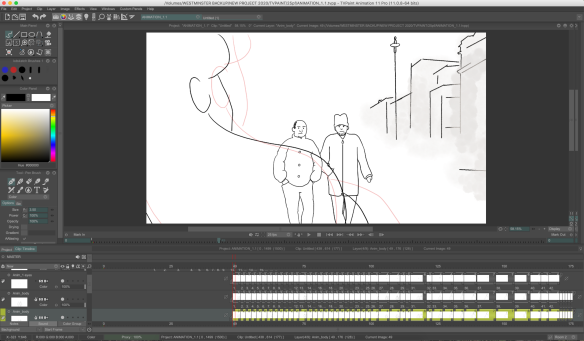
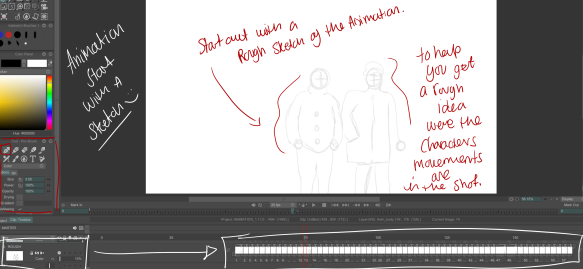
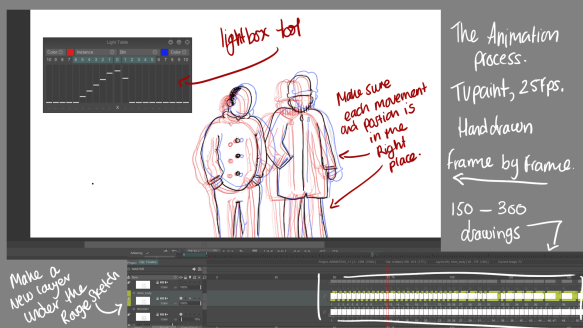
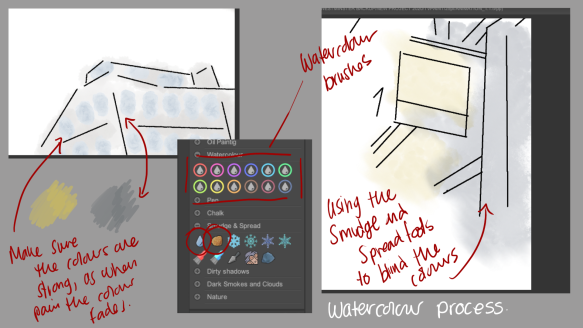
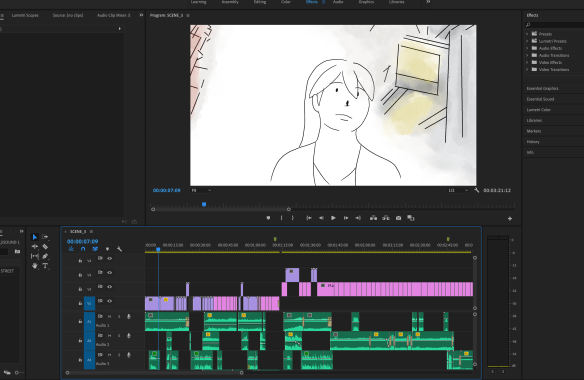
I have created three experimental clips, using photoshop I rotoscoping some clips of a cat in slow motion. By using oil pastel design in the background to show off the texture with the digital animation. I have also been using different types off brushes to show off style.

Summer Research Essay

Summer Research Essay

Dziga Vertov is a Russian Soviet documentary filmmaker and a newsreel director from the 1920s. He is also known as a cinema theorist whose practices in the film and theories are used as references by modern-day filmmakers. His style and methods have influenced Cinéma verité from 1922 to 1968.

What stands out in Vertov’s film making is that he has used the camera to unveil truth or highlight subjects that are hidden behind crude reality. This is known as Observational Cinema, Michelson (1984) This was the first-time soviet cultures have seen this type of cinema. Furthermore, Vertov and his collaborator Aleksandra Medveadkin created a new non-fiction genre which pushed the boundaries to the point where it was life-threatening.

German expressions (1920) evoked people emotions with strange nightmare like visions and settings, they were heavily stylized and extremely visible to the eye.The French impressionist cinema crafted the essence of cinematography as it shot case the medium invented by the Lumiere Brothers.

Vertov’s Cinema Montage shared similarity to the German and French cinema movements in the 20s and created famous film editors known as the Kino-Eye affect. Vertov is different from German filmmakers in the 20s and that he didn’t use actors in his films, but he just filmed everyday people going about their daily lives.

Vertov’s most popular works of film were Man with The Movie Camera and Three Songs about Lenin. Before 1917 and after the Bolshevik revolution Vertov was a newsreel editor for Kino Nedelya a cinema committee film series shown in Russia. Lenin’s often quoted in 1922 that film is the most important of all the arts probably surprised contemporaries, not because he ranked film first, but because he included it among the arts at all. This distinguished early Soviet film from movies elsewhere in the world and helps to explain both early innovation and subsequent stultification. The Soviet Union was the first country to insulate domestic filmmaking from the give and take of market-based consumer demand. This is not to say that movies were not shown to make money. Although the Bolsheviks were in power, film was presented in several conflicting views of art, Brooks (1991)

Vertov liked to compile his newsreel footage into a documentary style. This made him interested in the mechanical basis of cinema. He liked to film the public in secret as though he was the eye off the camera. Vertov’s main filming techniques is montage. This means selecting and editing scenes to piece together to form a continuous whole. This was a very popular method used in silent films in the 1920s. Vertov’s main idea behind the Kino Eye was that the eye of the camera saw life more accurately than the eye of a human. The man with a movie camera is an excellent example of the Kino Eye effect and is considered as one of Vertov’s masterpiece. Vertov’s film shows complexity in both filming and editing without voiceovers or titles. It uses visual language to tell the story of the Soviet Union in 1929.

By watching the film Man and the Movie camera I was inspired to try out Vertov’s film techniques and his effects. I was impressed by the three main cinematic effect he used, and I wanted to achieve and explore them in my short film. These are the Dissolve, Split Screen and Double Exposure which bring dynamism in the film and are presented in a visually playful nature.

The way I did my film was that I took my canon camera with two zoom lenses picked three London locations that had a top-rated tourist attraction. This method enabled me to film the public secretly as though they were actors in a film. The central locations I picked were Waterloo, Trafalgar Square and Great Portland street Station. Although my short film shows modern-day footage, I changed the colour to black and white as I wanted to show a lot of timeless quality. This also shows that my film is a throwback to photographic past and it shows the audience that it is a representation of Vertov’s work.

The 1920s increasingly used the Dissolve effect which has multiple occurrences in The Man and The Movie Camera. Its final frame of one image is briefly laid over the introductory of the next frame; it is the oldest form of film transition. In my film, I was able to achieve this effect easily and quickly with modern day technology.

For the Split-screen, nowadays we have the editing software like Adobe to help us achieve this effect quickly. But in the 1920s, Vertov used his hand cracked 35mm camera and would have to cover the part of the lens to create the first image with an empty half, and then reshoot the same strip to fill in the gaps. I enjoyed using this effect in my film as it focuses on different actions at the same time and is a very eye-catching effect. In my film I took two different shots and placed them next to each other and used a feather effect in the middle to help blend in the footage.

Double exposure was where my knowledge of editing was put to the test. I have never done this effect before in my films, so I was very eager to learn it for my film. Moreover, I admired how Vertov used this effect in the scene with a cameraman going into a pint glass. In the 1920s, this effect was achieved by exposing the same strip of film to different moving or still images and overlaying them. Nowadays, in the 20th century, computer trickery, Adobe, helped me to achieve double exposure by having a camera image over a moving image of tourists.

By exploring Vertov’s cinematic techniques I was able to learn a lot about the cinema in the 1920s. This helped me create my own film that has a good representation of those techniques.

 References

Jeffrey Brooks (1991) Russian Cinema and Public Discourse, 1900–1930, Historical Journal of Film, Radio and Television, 11:2, 141-148

Michelson, A. (1984). Kino-eye. Berkeley: California University Press.

Dziga Vertov, a guide to references and resources, Feldman, Seth R.; 1979, Boston: G. K. Hall

https://en.wikipedia.org/wiki/Dziga_Vertov

https://www.calvertjournal.com/features/show/8315/revisiting-revolution-vertov-medvedkin-soviet-documentary-cinema

https://www.bfi.org.uk/news-opinion/news-bfi/features/five-wonderful-effects-man-movie-camera

https://en.wikipedia.org/wiki/Kino-Eye

Minor Film Documentary Proposal

For my documentary film, my theme will be cats and mental health. I would like to focus on people who suffer from depression and anxiety and the stories they have about their life-changing experiences when acquiring a cat as a pet, which helps them to cope when they have a mental health episode.


This is an unusual subject that people may or may not know, but owning a cat has proven to have beneficial therapeutic qualities, and I would love to show how cats can reach out to us and provide a fantastic source of comfort. I feel this is a substantial subject matter that will inspire its target audiences and show them the other side of these fluffy creatures that they never knew before. 


“In 2011, the mental health foundation carried out a study in partnership with cats protection and interviewed 600 people, both cat owners and non-cat owners. half of them described themselves as having a mental health problem.”


“87%mof cat owners said it had a positive impact on their wellbeing and 76% said they coped better with daily life thanks to the companionship of their cat.”


To explore this subject matter I want to interview cat owners and non-cat owners, similar to the case study undertaken by the heath foundation, but I would also like to interview cat charity teams and speak to customers and staff in cat cafes, in order for them to share their stories and opinions to the world.


Influences: 


Still Life with Animated Dog by Paul and Sandra Fierlinger. 


https://vimeo.com/264361557


This animated short was of particular interest, even though it focuses on a different topic to mine. I still felt it had the same wavelength. It was vital for me to research animated documentary that centres around wild animals or pets and this was a perfect example. 


These four dogs helped shape Fierlingers evolution as an artist and as a man, by using vivid 2D animation that illustrates the adventures of the endearing dogs who shared their owner’s journey. 


This film comes across as a personal narrative, but it is presented in a documentary structure. It has also inspired me to explore and design concept art for backgrounds that will be for my future portfolio.


Cat’s Cradle by Jonathan Napolitano


https://vimeo.com/230666375


Even though there is minimal animation and the film is mainly in live-action, it is still a documentary that I can take ideas from. With this film, I wanted to focus on the emotional aspect of a couple who transformed their 1920s farmhouse into a hospice for senior cats. 


This gave me an idea for making my documentary in live-action but where some scenes are animated, for example:


“when characters are talking on a screen about there personal issues, some artist and filmmakers take that narration and create animated sequences over it and show the audience how creatively the filmmaker can manipulate the subject that’s presented on screen.”


This takes to my final influence:  


ABDUCTEES By Paul Vester  


https://vimeo.com/36996505


With this idea, it would be great to show different styles of animation while the narration is presented in the background. I would like to explore different movements of art. In Vester’s film there is a piece of narration that is unpleasant, showing a 2D sequence of aliens sticking an instrument up a woman’s nose. By incorporating an imaginative sequence that demonstrates what the woman is discussing, this highlights how you can really play with the narrative and for example create something that intercuts the narrative structure and does or does not relate to the topic.  


The Interview process, written up some simple question to ask my friend Gagandeep Kalirai who is not a cat owner, tells us her thoughts and opinions on the subject. And how she feels it would have excellent benefits for peoples who suffer mental health.

0